Pose-state ambiguity
Nearly identical joint configurations can correspond to different garment shapes because cloth retains momentum and deformation history.
ECCV 2026
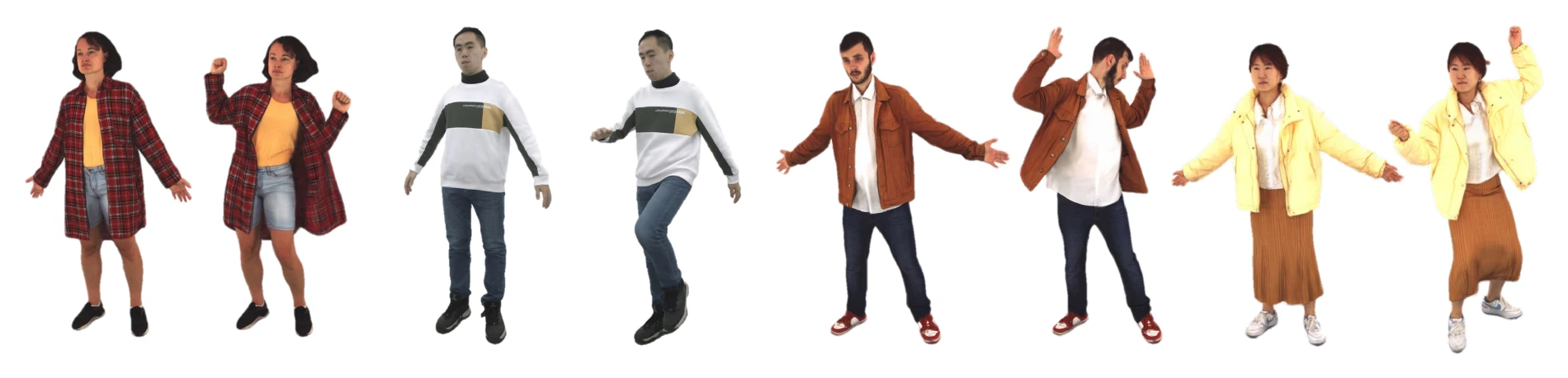
Creating photorealistic, temporally coherent animatable avatars from RGB video is difficult because the current skeletal pose does not uniquely determine garment state. Pose-conditioned models therefore tend to over-smooth cloth appearance, flicker over time, or fail on motion outside the training distribution. DSAR treats cloth as a causal temporal process with two complementary autoregressive streams: a geometric stream propagates the previous frame's predicted surface deformation, while a state stream retrieves historical temporal states from a memory bank. Motion-Adaptive Temporal Aggregation and motion-aware regularization accommodate spatially varying dynamics. Trained from multi-view photometric supervision, the framework improves rendering quality, temporal consistency, and generalization to unseen motion patterns.
The same standing pose can follow a rapid spin or a period of rest, yet the corresponding garment states differ because momentum, wrinkles, tension, and settling behavior depend on motion history. Skeletal pose records body configuration but omits both the observable evolution of the cloth surface and latent internal state. A model that maps pose directly to appearance therefore learns an ambiguous correlation instead of the causal transition between cloth states.
Nearly identical joint configurations can correspond to different garment shapes because cloth retains momentum and deformation history.
Skeletal input describes the body, but not the current cloth configuration, velocity, or directional momentum.
Fabric tension, material response, and deformation memory are latent properties that cannot be recovered from pose alone.
DSAR represents an avatar with a learnable canonical 3D Gaussian template bound to the SMPL-X surface through UV parameterization. At frame t, a StyleUNet processes a temporal window of pose-derived position and velocity maps together with the previous predicted cloth deformation. The geometric stream aggregates observable surface motion, while the state stream retrieves latent history from a memory bank. Their fused features predict frame-specific Gaussian deformations, which are transformed by Linear Blend Skinning and rendered through differentiable splatting.
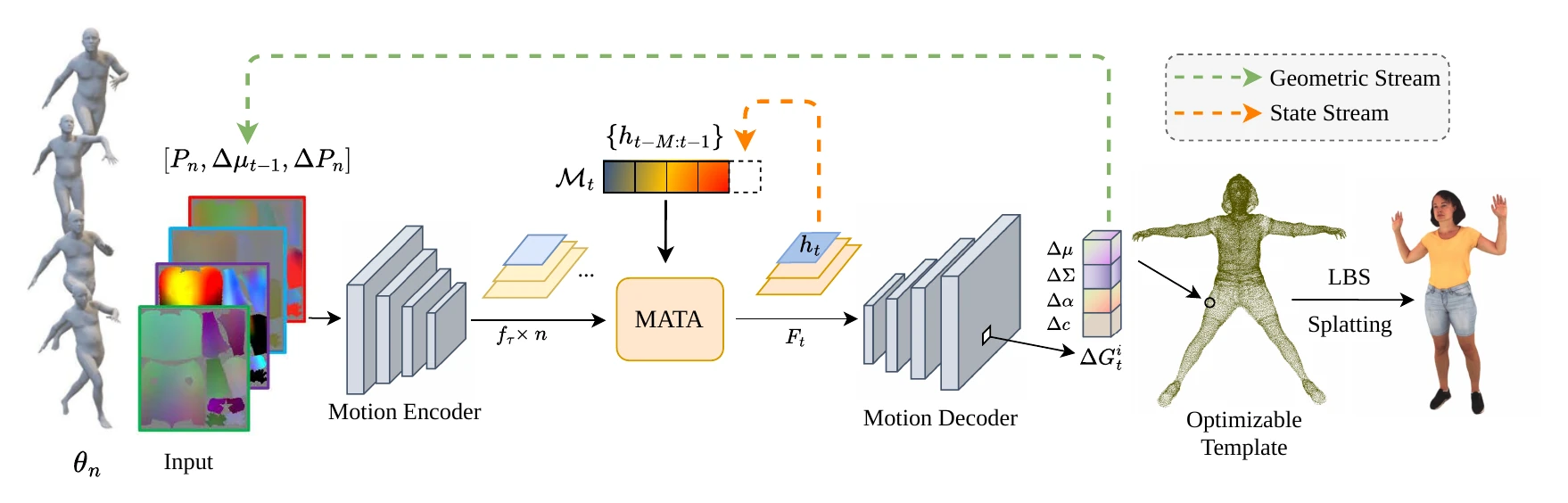
An optimizable template is bound to the SMPL-X surface through UV parameterization. The network predicts frame-specific changes in Gaussian position, rotation, scale, opacity, and color.
Position maps, velocity maps, and the previous predicted deformation enter the StyleUNet encoder. This feedback explicitly propagates observable cloth configuration and motion across frames.
A fixed-size memory bank stores recent temporal states. Cross-attention retrieves relevant history and fuses it with current geometric features to represent latent factors that geometry alone cannot observe.
Motion-dependent weights impose stronger consistency in static regions and relax feature, deformation, and trajectory regularization in fast-moving garment regions.
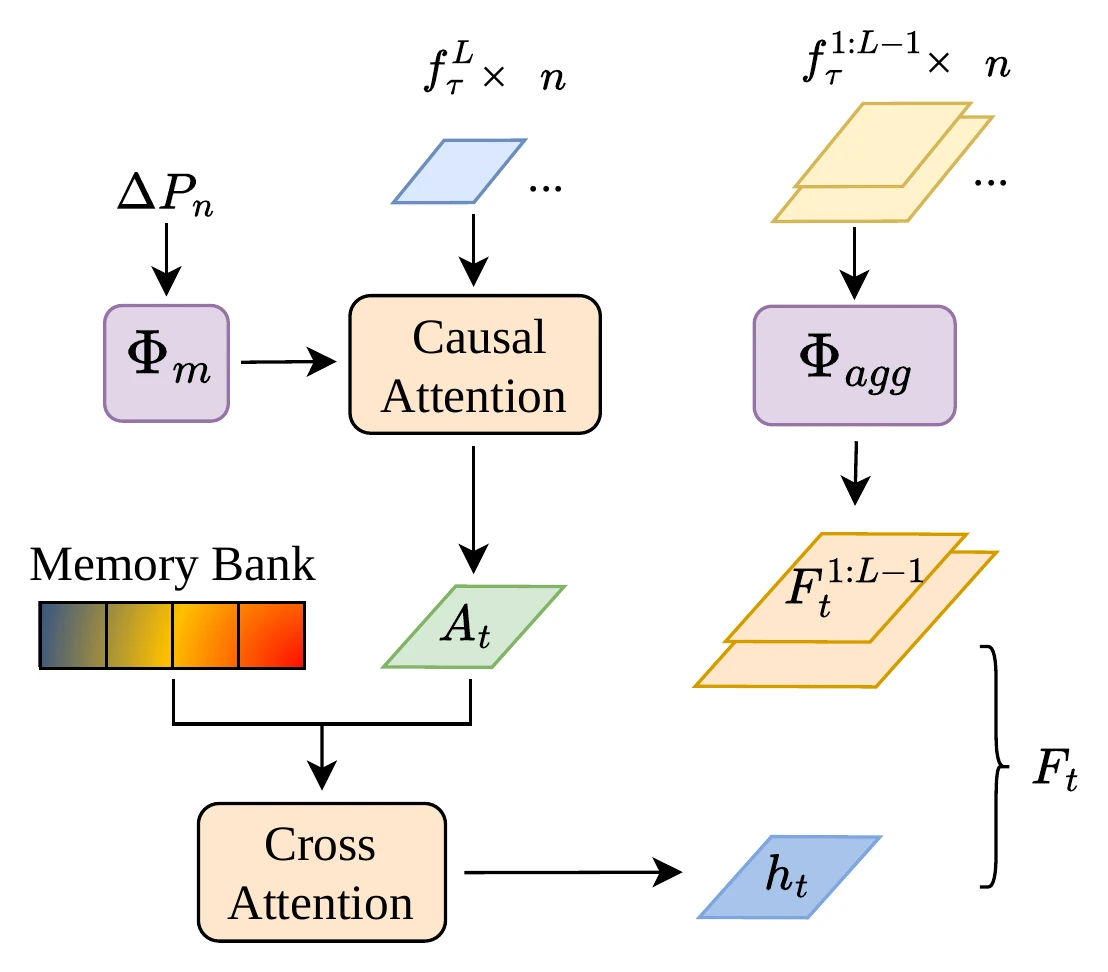
At the deepest feature level, spatial motion magnitudes and temporal position embeddings condition causal self-attention over the input window. High-motion regions emphasize recent evidence for transient dynamics, while stable regions can retain broader context. Lightweight temporal convolutions aggregate the finer feature levels efficiently.
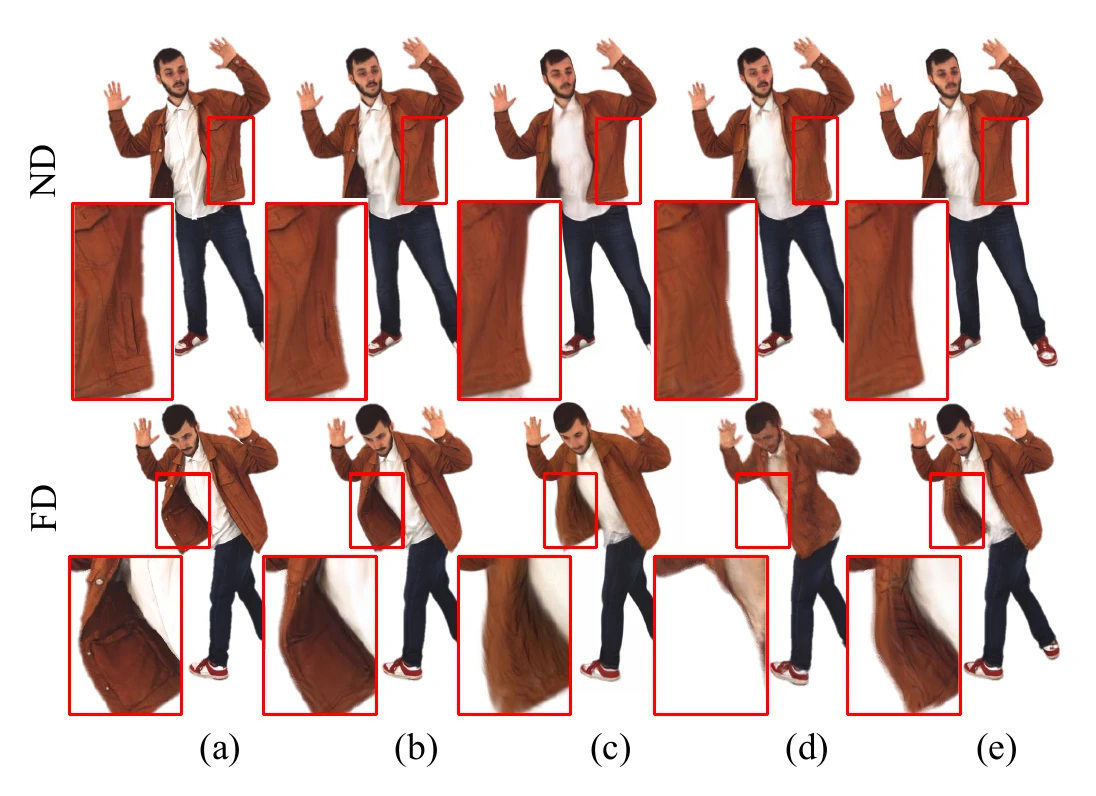
DSAR is evaluated at 940×1280 resolution on held-out sequences from 4D-DRESS and AvatarREX, with AMASS motion used to test far-distribution generalization. Under identical training data, DSAR outperforms HumanNeRF, GaussianAvatar, and Animatable-GS across PSNR, SSIM, and LPIPS while preserving momentum-driven garment deformation on challenging motion.
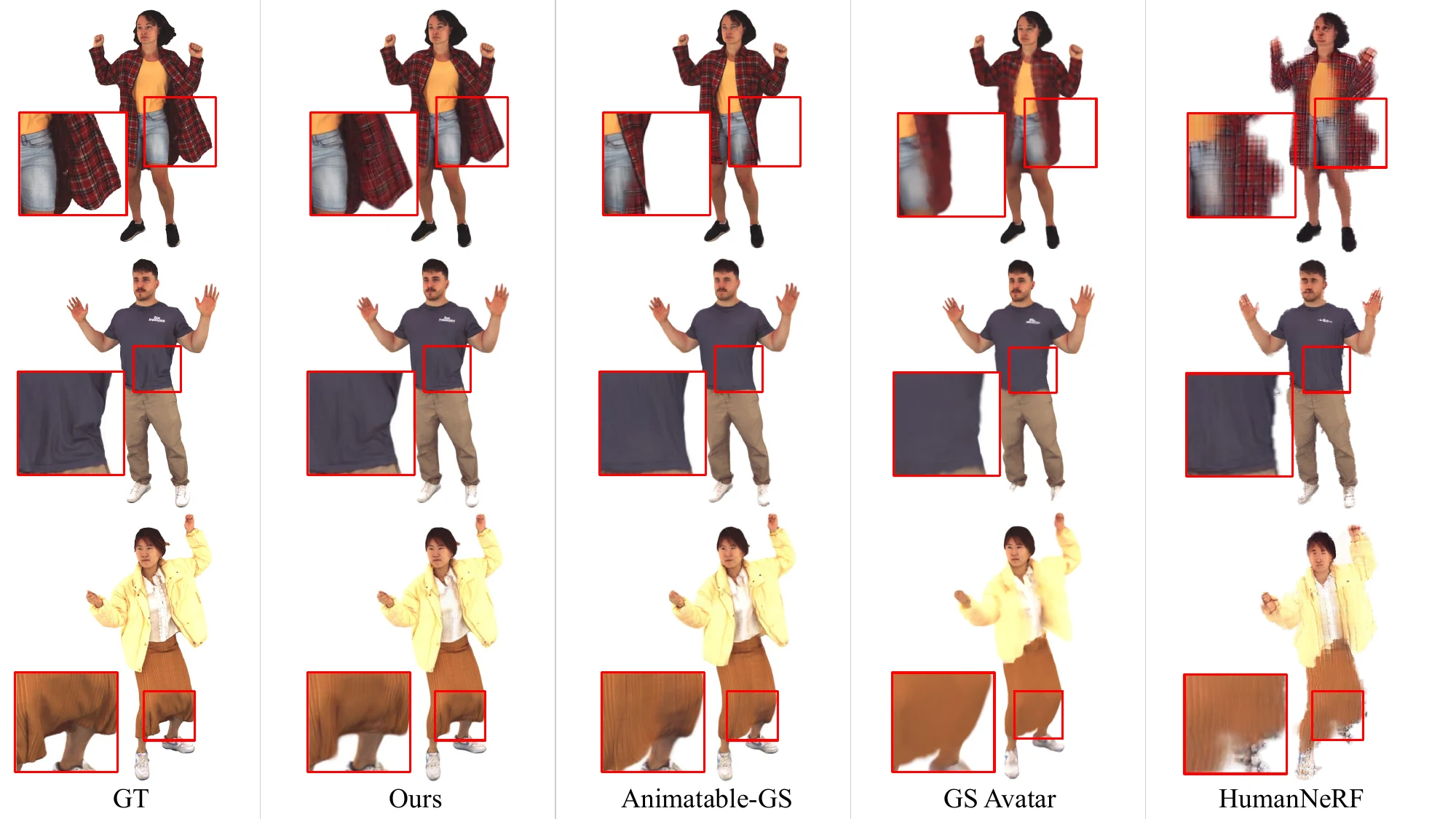
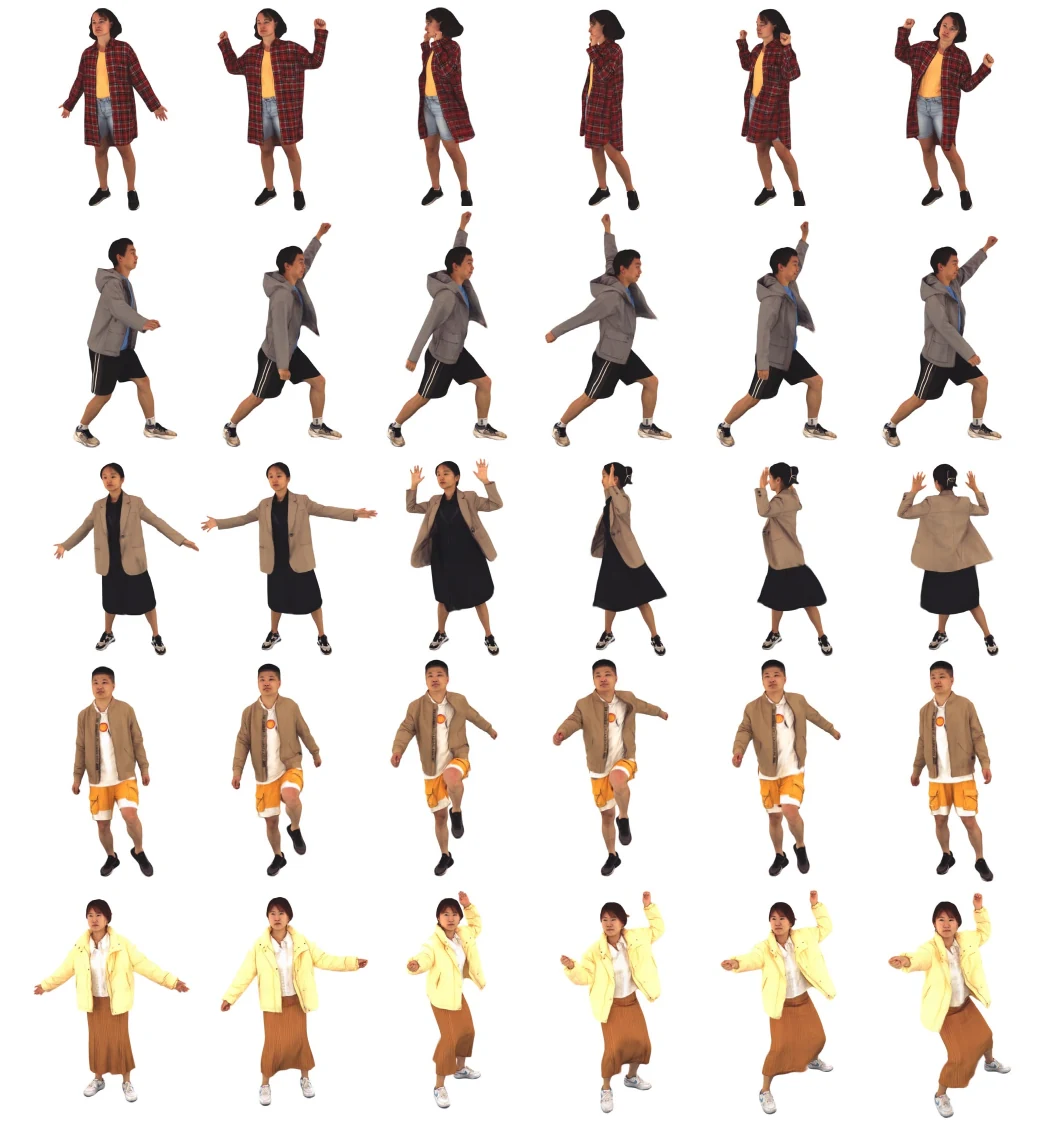
The supplementary video presents continuous animation sequences reconstructed from AvatarREX and 4D-DRESS. Loose jackets, dresses, and layered garments retain momentum, develop wrinkles, and settle over time instead of snapping to an appearance determined only by the current pose.